
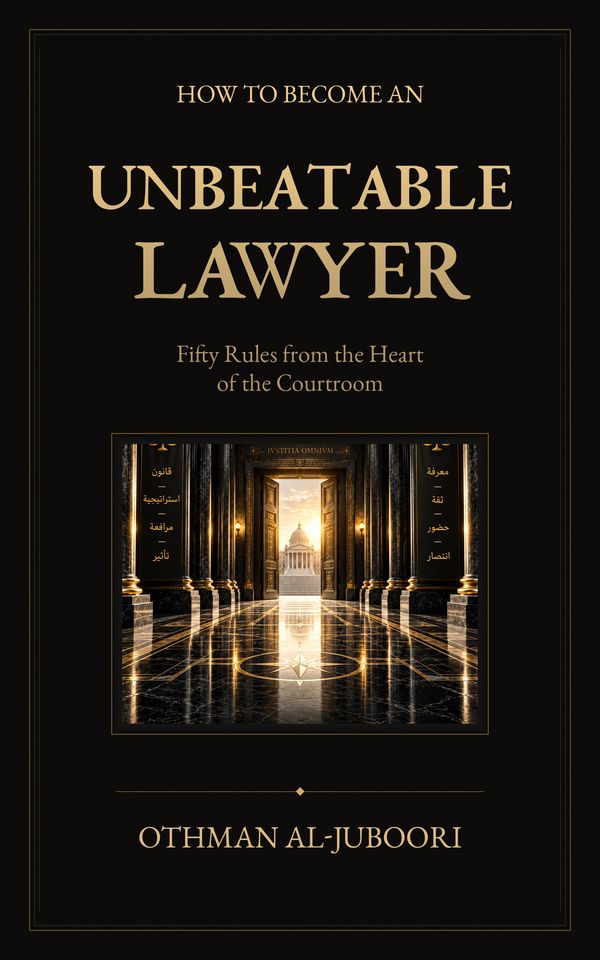
Fifty Rules from the Heart of the Courtroom
by Othman Al-Juboori
Also available in Arabic: كيف تصبح محاميًا لا يُقهر
About the book
Knowing the law is only half of a lawyer’s job. The other half happens in the courtroom: under pressure, in front of a judge, facing an opponent who watches every reaction.
Drawing on years of legal practice in Iraq and more than 2,000 cases before civil, criminal, commercial and labour courts, lawyer Othman Al-Juboori distils what law school rarely teaches into fifty practical rules of trial advocacy. Learn why you should never speak before you know what you want from the court, why you should open with your strongest point rather than the middle, how silence can be an invisible weapon, how to keep surprise from turning into visible confusion, why grand promises to a client can recoil on you, and why you must never let the hearing record tell a different story from what happened.
Every rule follows the same clear structure: the core idea, why it matters in practice, an illustrative courtroom example, concrete steps for applying it, the situations in which the rule fails, and a closing golden takeaway.
This is not a book of tricks. Every tactic is subordinate to the law, procedure and professional duty, and the author is candid about each rule’s limits.
Written for new lawyers, trainee advocates, law students and experienced practitioners who want a calmer, sharper courtroom presence, and a law career built on a reputation that outlasts any single case.
Contents
These are the fifty rule titles from How to Become an Unbeatable Lawyer: Fifty Rules from the Heart of the Courtroom by Othman Al-Juboori. The titles are copied from the book’s contents; the grouping by theme is the book site’s, to make the list easier to use before a hearing.
Preparation and case strategy
- Rule 2 Understand Your Case First, Then Understand How to Convey It to the Judge
- Rule 3 Do Not Take on a Case Before You Understand Its Legal and Procedural Terrain
- Rule 9 Do Not File a Case Before Mapping Its Possible Outcomes
- Rule 16 Do Not Speak Before You Know What You Want from the Court
- Rule 27 Never Enter a Hearing Without a Plan—or Leave Without a Note
- Rule 34 Never Leave a Hearing Without Knowing What It Achieved
- Rule 44 Enter Each Hearing Knowing the Material Weakness in the Opponent’s Position
- Rule 45 Make the Core of the Case Clear Before the Hearing Ends
Composure and courtroom presence
- Rule 1 Do Not Show Your Weakness: Your First Breakdown Will Turn the Entire Balance of Power Against You
- Rule 8 Do Not Let Your Opponent See Your Anger: Anger Reveals Your Secrets
- Rule 13 Do Not Let Surprise Become Visible Confusion
- Rule 22 Do Not Raise Your Voice—Give Your Words Weight
- Rule 23 Do Not Show Your Opponent Where You Are Anxious or Underprepared
- Rule 26 Do Not Speak So Fast That Your Message Becomes Confused—Clarity Matters More Than Haste
- Rule 35 Do Not Show Anger at an Adjournment—Use the Time to Your Advantage
- Rule 36 Do Not Let Haste Disrupt Your Courtroom Presence
- Rule 39 The Argument Comes First—Professional Presence Carries It
- Rule 42 Do Not Sit in Court Like a Visitor—Be Part of the Proceedings
- Rule 43 Do Not Show That the Opponent Has Unsettled You—Even Under a Full-Force Attack
- Rule 46 Do Not Celebrate in Court—Save Victory for After the Judgment
Oral argument and persuasion
- Rule 5 Silence Is an Invisible Weapon
- Rule 6 Do Not Spoil a Clear Argument with an Unnecessary Summary
- Rule 7 If You Are Given the Last Word, Make It the Most Effective
- Rule 10 Do Not Rely Only on the Strength of Your Argument: Consider How You Present It
- Rule 11 Do Not Answer Questions That Have Not Been Asked, or Justify What Needs No Justification
- Rule 12 Do Not Begin Your Defence in the Middle: Start with Your Strongest Central Point
- Rule 21 Do Not Rely on the Court’s Memory—Keep the Core of Your Argument Clear
- Rule 30 Do Not Lecture the Judge on the Law—Present It Clearly and Respectfully
- Rule 31 Do Not Repeat the Same Words—Reinforce the Idea in Different Ways When Needed
- Rule 40 Do Not Turn Advocacy Into Theatre—Persuasion Matters More Than Performance
- Rule 47 Do Not Leave the Judge’s Question Unanswered or Unaddressed
Dealing with the opponent
- Rule 4 Do Not Fight the Battle Your Opponent Chooses
- Rule 14 Do Not Fight on Every Front: Choose Your Main Battles
- Rule 15 Do Not Turn Litigation into Personal Enmity: The Judge Decides on Law, Not Feelings
- Rule 17 Do Not Build Your Defence on Denying Everything
- Rule 24 Do Not Chase Every Point at a Hearing—Choose What Deserves an Answer
- Rule 32 Do Not Be Rigid About Everything—Be Flexible Where the Substance of Your Position Is Untouched
- Rule 38 Do Not Reveal Your Strategy Prematurely—But Disclose Everything the Law Requires
Evidence, documents and the hearing record
- Rule 18 Do Not Let the Hearing Record Tell a Different Story from What Happened
- Rule 20 Do Not Attack Evidence Before Understanding the Source of Its Strength
- Rule 33 Do Not Trust a Client’s Document Until You Have Examined It as Though It Belonged to the Opponent
- Rule 37 Correct the Error Without Embarrassing the Court—and Preserve Your Client’s Rights
- Rule 41 Do Not Waste Your Document’s Strength—Time Its Presentation Within the Law
Client handling
- Rule 19 Do Not Let Your Client Surprise You with a New Fact
- Rule 28 Do Not Become a Party to the Dispute Instead of Its Lawyer
- Rule 29 Do Not Make Too Many Promises to Your Client—Promises Can Recoil on You
- Rule 48 Prepare Your Client to Speak—Do Not Leave Courtroom Answers to Improvisation
Professional ethics and reputation
- Rule 25 Do Not Defend Yourself in Your Submission—Defend the Legal Position
- Rule 49 Do Not Advertise Your Experience—Let Your Work Reveal It
- Rule 50 Advocate Not Only to Win, but to Remain Professional Whatever the Outcome
The book suggests you don’t memorise the list. Before each hearing, choose one or two rules that fit the situation you expect, then note afterwards what worked and what needed adjusting. Whenever a rule touches a document, a deadline, an objection or another party’s right, the applicable law and procedure come first.
Who is this book for?
Law students, trainee and newly qualified lawyers, and practising lawyers who want stronger courtroom skills: preparing a case, presenting an oral argument, answering the judge, handling clients and protecting their professional reputation.
About this edition
This English edition was translated from the author's Arabic original with the help of AI.
About the author
Othman Al-Juboori is an Iraqi lawyer, an expert in Iraqi labour law, and the founder and managing director of Al-Taswia Legal Services Company (Baghdad, est. 2018). He is based between Baghdad and Dubai. He has practised for many years, and in the book’s About the Author section he writes that he has appeared in more than 2,000 cases before civil, criminal, commercial and labour courts.
He wrote this book, he says, “to share what I wish I had learned at the beginning”: the professional lessons learned in court rather than in the classroom.
Buy the ebook
The English edition costs $6.99.